Chaos or Recovery? Buying Low in a World on Fire
Steve, Tom and Jacob on a world in upheaval, a sharemarket that has gone nowhere, the trouble with property yields, and four rules for buying low and selling high.
Five Things to Take From This Session
- Protests have spread across Europe, from France and Italy to Portugal and Albania, on top of conflict in the Middle East.
- Trump has paused the Russia sanctions Congress passed with large majorities, and it has not gone down well.
- The ASX has gone nowhere this year, but we think Australia's next decade looks brighter than the US's.
- Property yields are low, and even boring old bonds are now paying around 5%.
- Buying assets after big falls has historically paid off. The edge is a systematic way of doing it.
I. Geopolitics
Europe on fire
The Middle East is on fire, and now so are parts of Europe. In France, school protests grew into wider unrest over living costs, with more than 2,000 arrests. Italy has seen riots in Turin, Bologna and Milan. Albania's anti-corruption protests have escalated, and housing protests have spread through Lisbon and Porto. Is the world on fire?
Read:Social unrest sets Europe's streets ablaze The Gleaner →
TACO time
Markets have a nickname for Trump backing away from his own threats: TACO, short for “Trump always chickens out”. This time it was Russia. Congress passed a sanctions bill with large majorities in both houses, Trump signed it, and then on 16 October he paused it two days before it was due to take effect, citing the national interest. It does not appear to be going down well. Co-author Senator Richard Blumenthal said the waivers had “nothing to do with our national security.”
Read:Trump puts new Russia sanctions on hold Associated Press →
The US midterms
The US midterm elections are on 3 November. Some commentators have openly asked whether the US should prepare for martial law. For balance, the chairman of the Joint Chiefs of Staff has written to Congress saying the military has no plans to send troops to polling places. We will be watching closely all the same.
Read:US military has no plans to send troops to the polls in November, top general says Associated Press →
Friends or Enemies?
The US threatens Europe over Starlink spectrum plans
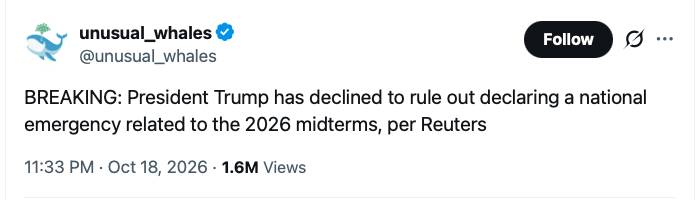
Source: Financial Times.
Monty Python time
After all that, a little perspective from the Monty Python crew.
Keep Calm
Some advice for the week

With apologies to Monty Python's Life of Brian.
II. The Oz Economy
The ASX has spent the year going nowhere, so there is not a lot to say at the aggregate level, though some sectors including energy have outperformed. It does show why we focus on rebalancing over shorter periods: we believe there is a high probability US shares do not advance over the next decade.
All Ordinaries, Year to Date
Down around 1% for 2026 so far
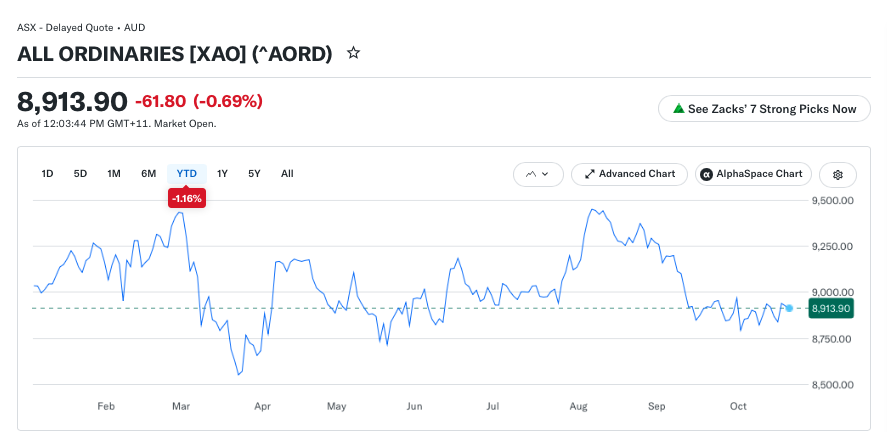
Source: Yahoo Finance, October 2026.
We think Australia will do well from here. Global investors have treated us like an emerging market: a commodity exporter whose banks send most of their lending into property speculation. With commodity prices struggling for a while, a mundane ASX return is no surprise. We believe the next decade looks a lot brighter.
It is hard to offer certainty when the world is in constant, shifting upheaval. Every country is under pressure from the unwinding of 40 years of globalisation, as wars and trade frictions break it apart. Australia cannot stand outside that reordering. The best we can offer is constant monitoring of the global and local impacts.
Globally, Australia still sells its minerals and agriculture. Economists have long lamented that we never moved up the value chain, but we are doing relatively well. Some country will always want our commodities to manufacture goods for export.
Locally, the government remains fixated on returning the budget to surplus, but the big concern is falling house prices. Plenty of property commentators still promote housing as a good investment, often by simply stretching the time frame. Flipping for capital gains is largely dead, so the pitch has shifted to “investing long term”. But rental yields are extremely low and unattractive next to the alternatives. Even boring old bonds are paying around 5%.
Properties Selling Under Asking
Share of sales completing below the original listing price, last three months
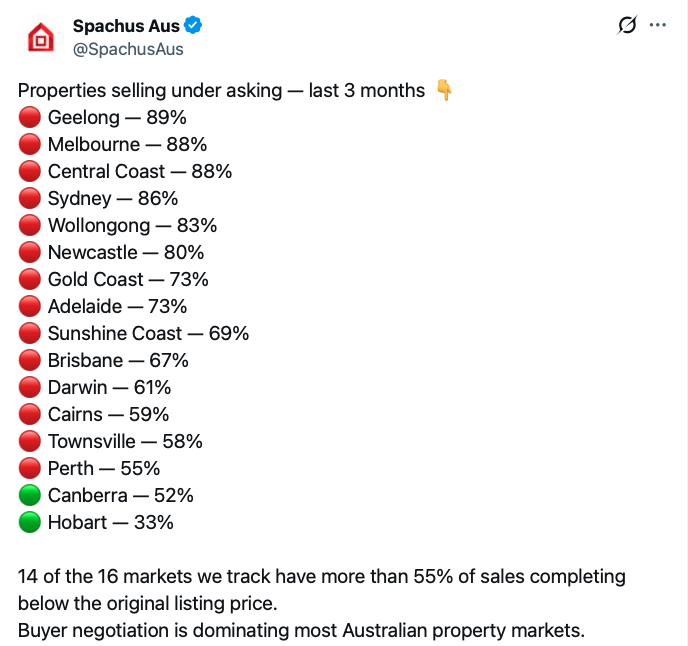
Source: Spachus Property Price Tracker, October 2026. 14 of 16 markets above 55%.
So all we can offer is a running commentary, and it could be blindsided by a Black Swan at any point.
III. What's Your Edge?
“If not now, when?” The ancient sage Hillel was warning against procrastination. Good intentions mean nothing if they are always delayed. If you do not start now, you may never start at all.
Or, as one observer put it in 1932, in the depths of the Great Depression: “We are going to have either chaos or recovery.” Either way, the investors who did best were the ones prepared to act when assets were cheap.
Buy Low, Sell High
What happens when you buy assets that have fallen 60 to 90%
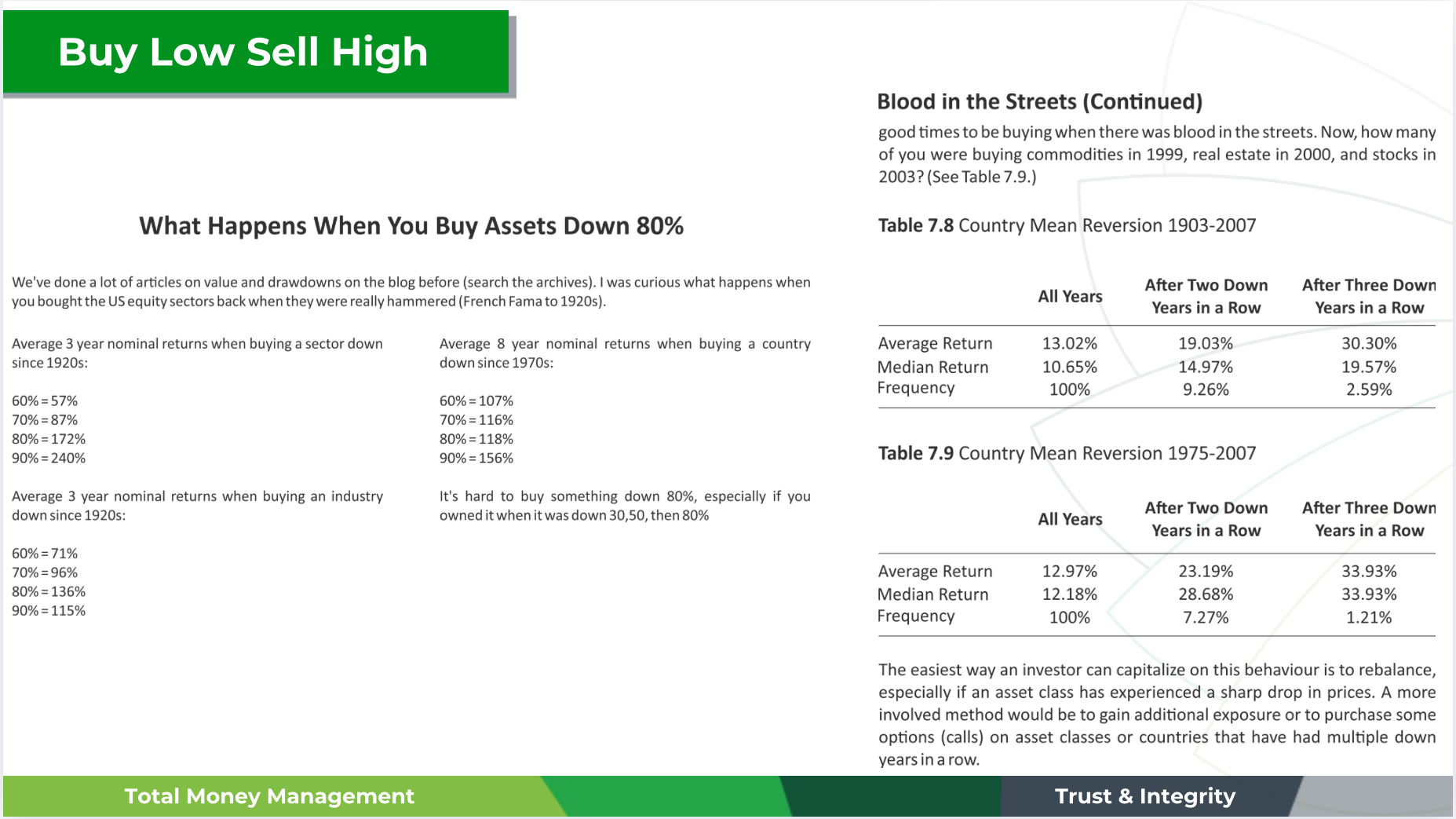
Research by Meb Faber, using Fama-French and global market data.
A few rules to take from it:
- Don't chase perfect timing. Nobody times every investment perfectly over 20 or 30 years.
- Think in probabilities over the long term. The chart shows that buying undervalued assets really has worked. Understand asset allocation and you can build a buy low, sell high process.
- Have an edge, and make it systematic. A repeatable way of buying low and selling high. It won't work every time, but it has worked over time.
- Be a contrarian. Swimming against the crowd feels hard, but buying low and selling high works. It takes a little bravery and some knowledge.
Listen to the Full Episode
On Spotify, Apple and YouTube. Leave a review to help us grow.
Want the full weekly analysis? Join Signals & Noise Premium for $9.99 a week, or see how we work with clients one on one.
This newsletter is for informational purposes only and does not constitute financial advice. Total Money Management | AFSL 568642.