Australia's Debt Double Standard: Government Deficits vs Household Debt
Sep 28, 2026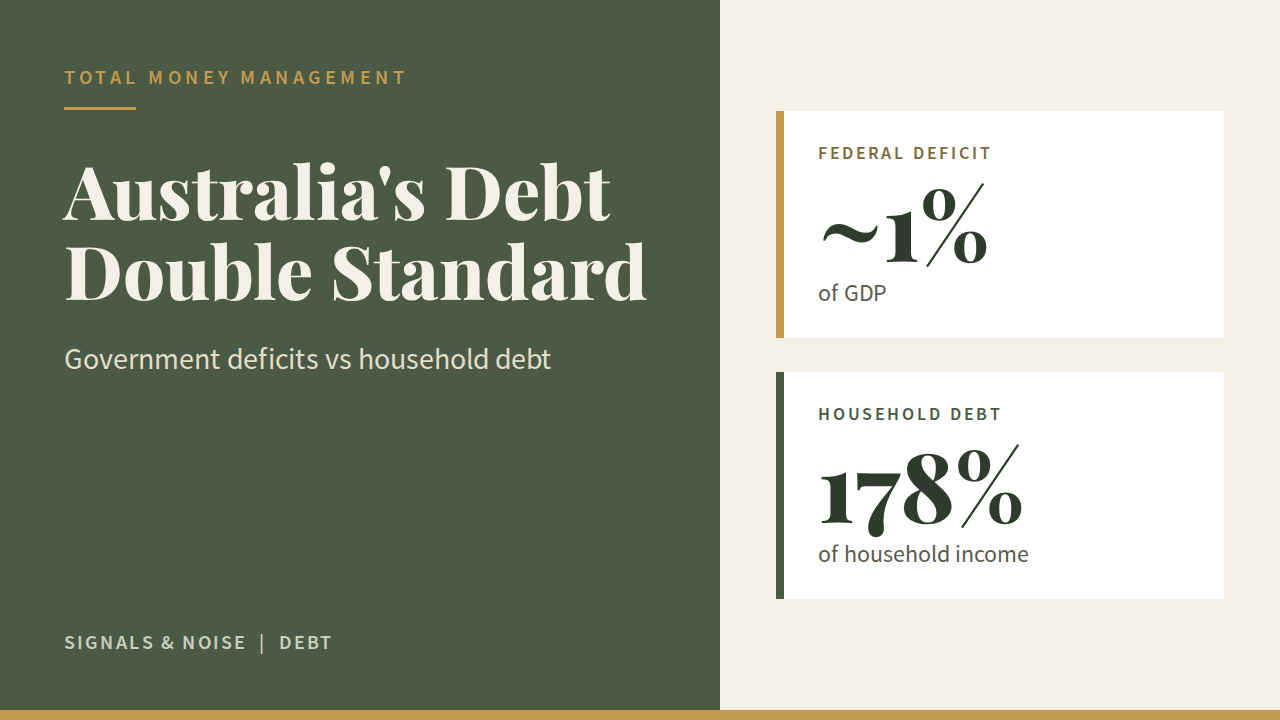
Every week you hear a version of the same argument: government deficits are dangerous, spending needs to be cut, debt is out of control. Meanwhile, a different kind of debt, the kind households take on to buy and speculate on property, barely gets a mention in the same breath. That is one of the ideas we picked up in this week's Signals & Noise, and it is worth sitting with for a minute, because when you look at the numbers, the story runs the other way.
The numbers behind the debate
Government debt is smaller than the headlines suggest
Australia's 2026-27 federal budget deficit sits at roughly $31.5 billion, or about 1% of GDP. Gross government debt is around 34% of GDP and net debt around 20%. Those are not small figures, but they are also not the runaway crisis that budget-night commentary sometimes implies. Treasury expects the deficit to hold near 1% of GDP for the next few years before gradually narrowing.
Household debt is a much bigger number
Compare that to household debt. Reserve Bank data puts Australia's household debt-to-income ratio at close to 178%, meaning households owe roughly $1.78 for every dollar of disposable income they bring in each year. Housing debt alone makes up around 135% of that figure. This is the debt that funds most property purchases and, in plenty of cases, leveraged property speculation rather than simple home ownership.
Side by side, the household number dwarfs the government number. Yet the political and media conversation runs almost entirely in the other direction.
Why the double standard exists
Part of the answer is structural. Every growing economy needs more debt somewhere in the system, whether that is private borrowing or a bigger government deficit. Australia's real GDP growth and its budget deficit tend to move together for a reason: someone has to spend more than they earn for the economy to expand, and right now a meaningful share of that spending is funded by household borrowing against property.
Part of the answer is also about who feels the debt directly. Government deficits are abstract. Nobody gets a monthly statement from the Commonwealth. Household debt is personal. It shows up in a mortgage repayment, and because it is personal, it also tends to feel more earned or more acceptable, even when the aggregate numbers say otherwise.
Why this matters for how you think about risk
None of this is a call to panic about either number. It is a reminder to separate the story you are told from the maths underneath it. If your instinct is to treat government spending as reckless and household leverage as normal, it is worth asking why, because the size of the numbers does not support that instinct on its own.
This kind of one-sided thinking about risk is not limited to debt. Mark Spitznagel, the hedge fund manager and long-time business partner of Nassim Taleb, has spent the past year warning that markets are being pushed higher by forces that are, in his words, real but dangerously one-sided. His concern is not that markets will fail to go higher first. It is that when conditions run in one direction for long enough, the eventual correction tends to be sharper than people expect, because nobody has priced in the other side of the story.
The lesson carries across both examples. Whether it is the debt conversation or the market conversation, ask what you are not being shown. The full picture is rarely as one-sided as the headline.
Your own reaction to risk shapes how you read numbers like these. If you want to understand yours, take the free TMM investor personality assessment.
The takeaway
Government deficits and household debt are both part of the same economic system, and neither exists in isolation. Understanding how they interact, rather than picking one to blame, gives you a clearer picture of where real financial risk sits. That clearer picture is the whole point of paying attention to signals over noise.
Keep reading the signals, not the noise
Signals & Noise is our weekly look at what the data is actually saying about markets, property and the economy. Here are three ways to keep going:
Listen to the free Signals & Noise podcast, with 120+ episodes on markets, property and investor psychology.
Start our free ETF course if you are new to investing and want the fundamentals in plain English.
Join Signals & Noise Premium to get our deeper weekly analysis and Q&A first.
This newsletter is for informational purposes only and does not constitute financial advice. Total Money Management | AFSL 568642.
Enjoying our blog?
Join Signals & Noise, our free weekly newsletter, and stay sharp on the markets and sectors we're tracking.
This newsletter is for informational purposes only and does not constitute financial advice. Total Money Management | AFSL 568642.
Stay connected to our blog
Join our mailing list to receive the latest news and updates from our team including blogs, live events, podcast releases and stocks to watch.
Your information will not be shared.
We hate SPAM. We will never sell your information, for any reason.
