Cash Pays 5.5%: The Real Opportunity Cost of Where You Park Your Money
Oct 09, 2026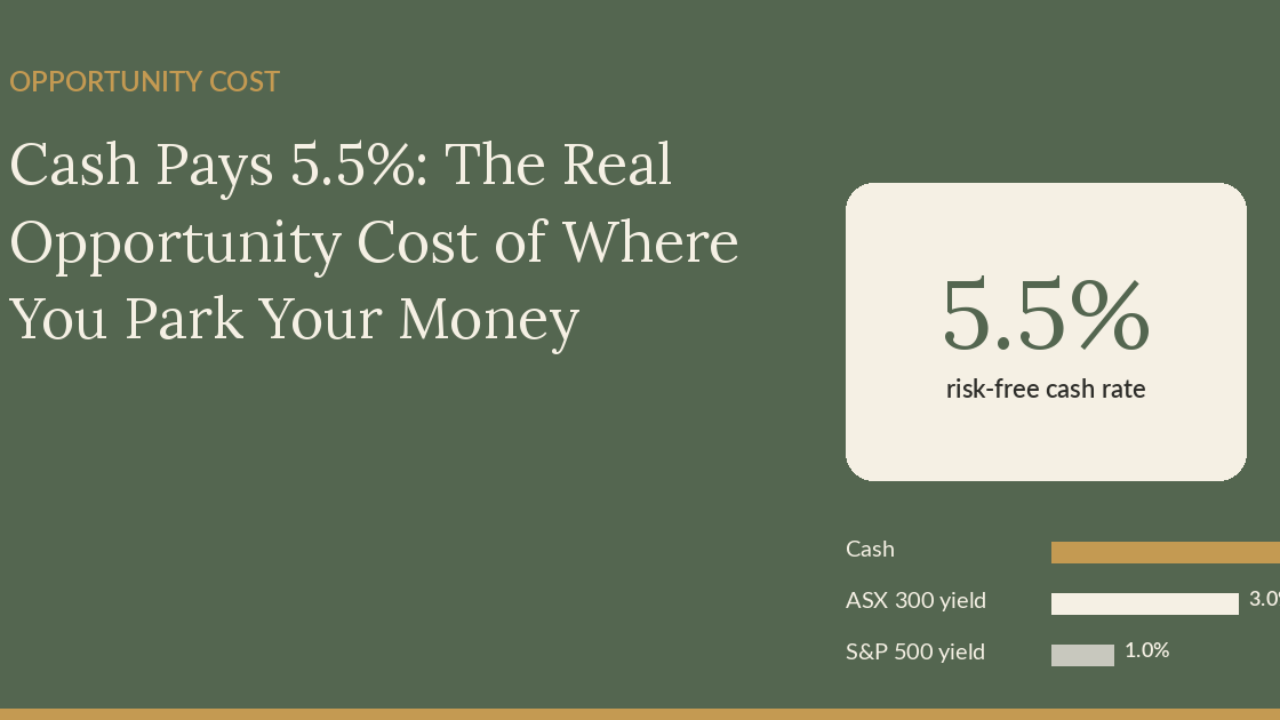
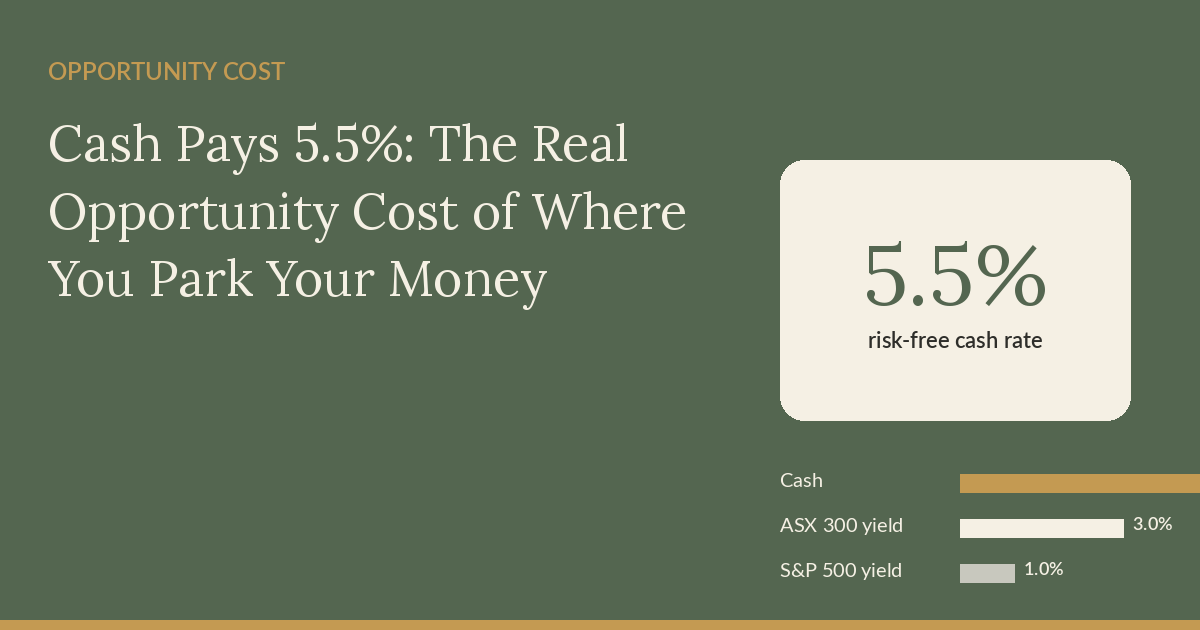
Right now, risk-free cash pays around 5.5% a year. That single number is doing more work in the Australian investment landscape than most people realise, and it is worth sitting with before you decide where your next dollar goes.
The iron law of investing: opportunity cost
Every dollar you put into one asset is a dollar not working somewhere else. That is opportunity cost, and it is the real bar every investment has to clear. It is not enough for an investment to make money. It has to make more than what you gave up to hold it, after adjusting for the risk you took on.
For a long stretch after the GFC, cash paid next to nothing, so this comparison barely mattered. Shares, property, anything with a pulse looked good next to a savings account paying 0.5%. That backdrop has changed.
Where the numbers stand right now
The RBA held the cash rate at 4.35% at its August 2026 meeting, the second straight hold, with the board still watching inflation before it moves again. High interest savings accounts and term deposits are passing much of that through, with some accounts advertising around 5.5% to 6%.
Compare that to where growth assets sit today. The S&P 500 dividend yield is now about 1.03%, the lowest level on record. The ASX 300 dividend yield sits around 3%, well below what cash pays with none of the market risk attached.
That does not mean shares are a bad idea. Dividend yield is only one part of the total return picture, and shares can still deliver through capital growth over time. But it does mean the yield argument for holding growth assets over cash is weaker than it has been in years. Whatever return you are chasing beyond the cash rate needs to be earned through something other than yield alone.
The private credit trap
Into this gap has stepped a wave of private credit offerings advertising 7.5% to 8%, often paid monthly. On the surface, that looks like an easy decision next to 5.5% in a bank account.
It is not that simple. Most of these returns are generated by lending against property, in a market where property headlines have been getting worse, not better. ASIC has flagged private credit as a 2026 enforcement priority, warning that retail investors are increasingly accessing opaque, complex private credit products at low entry points, in some cases through their superannuation, without always understanding what sits underneath the return.
Higher yield exists because of higher risk, not because a manager has found a shortcut. Before any yield figure means anything, you need to know what the fund is actually lending against, how it values that collateral, how liquid your money is if you want it back, and what happens if a borrower defaults. A yield with none of those questions answered is not a yield, it is a promise.
How to think about this, not what to do
This is not a call to move everything into cash, and it is not a call to avoid shares or private credit altogether. It is a prompt to run the comparison properly.
Ask what your money needs to do and by when. Cash is well suited to money you need in the next one to three years, or money you are holding as a buffer. It is poorly suited to money meant to grow over a decade or more, because inflation and opportunity cost erode it quietly while it sits still.
Ask what risk you are actually being paid for. A 3% dividend yield on shares comes with the long run growth history of equities behind it. A 7.5% private credit yield comes with concentrated exposure to a single loan book, often illiquid, often opaque. These are not the same kind of 7.5% as each other, let alone the same kind of return as cash.
Ask whether you are diversified across all of it, rather than picking the single highest number on a page and moving your whole position there. Chasing the top yield in isolation is how investors end up overweight in exactly the kind of asset that looks safest right before it is not.
The bottom line
Cash at 5.5% has raised the bar for every other asset class, and that is a healthy thing for investors to notice. It does not mean cash is the answer. It means every other option now has to justify itself against a real, positive alternative, rather than against a savings account paying almost nothing. That is a much better discipline to invest with than most of the last fifteen years allowed.
If you want a framework for thinking through decisions like this one against your own goals and risk tolerance, that is exactly what a Total Money Management coaching program is built for. You can also use our free investor personality assessment as a starting point for understanding your own risk tendencies.
For a weekly read on where opportunities like this sit, subscribe to Signals & Noise, our free newsletter, or catch the full conversation on the TMM podcast.
This newsletter is for informational purposes only and does not constitute financial advice. Total Money Management | AFSL 568642.
Enjoying our blog?
Join Signals & Noise, our free weekly newsletter, and stay sharp on the markets and sectors we're tracking.
This newsletter is for informational purposes only and does not constitute financial advice. Total Money Management | AFSL 568642.
Stay connected to our blog
Join our mailing list to receive the latest news and updates from our team including blogs, live events, podcast releases and stocks to watch.
Your information will not be shared.
We hate SPAM. We will never sell your information, for any reason.
