How Do You Know Where You Are in the Market Cycle?
Jul 23, 2026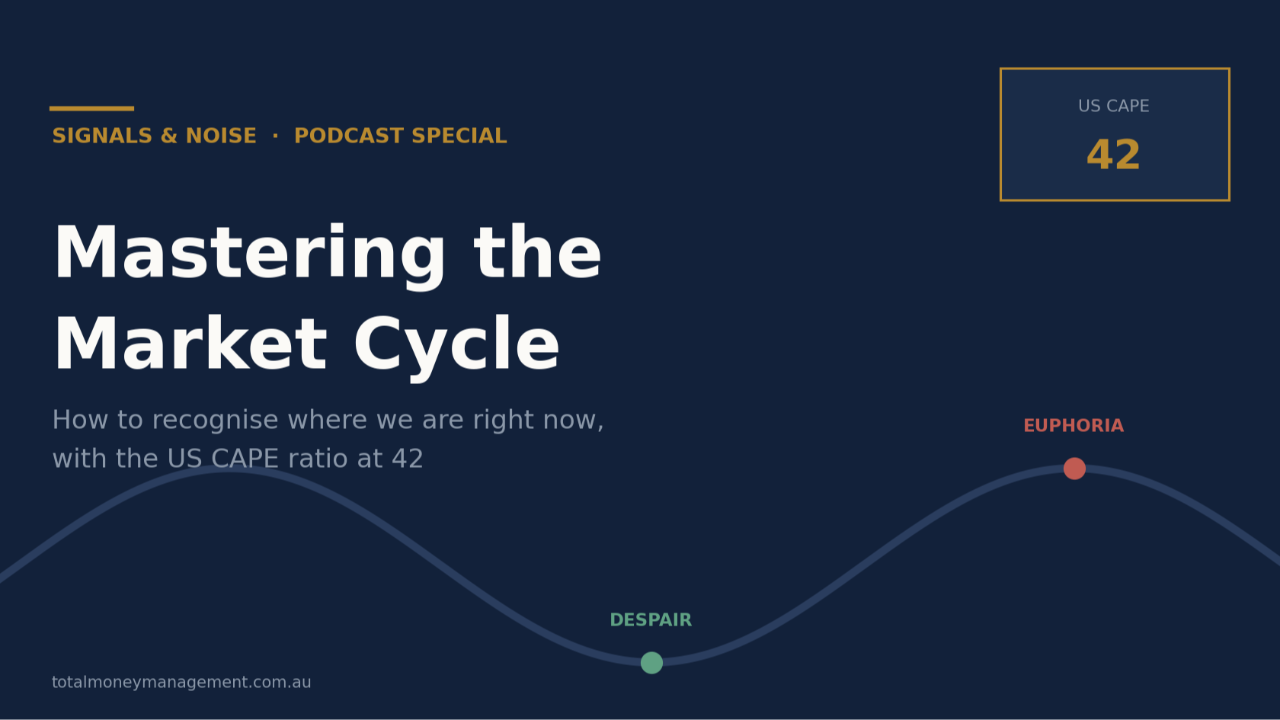
Every few years the same question does the rounds: is the market about to crash, or is this the start of something bigger? It is the wrong question. The better one is where are we in the cycle, because cycles do not announce their turning points, but they do leave fingerprints. This post works through the framework we discussed on the latest episode of the Signals & Noise podcast, drawing on Howard Marks's book Mastering the Market Cycle: why cycles exist at all, what the CAPE ratio tells you about the decade ahead, and how to combine valuation with trend so your decisions come from a process rather than a feeling.
Why do markets move in cycles?
Because people do. It is easy to talk about "the market" as though it were a machine, an objective thing with no feelings attached. But the market is just a large group of people buying from and selling to each other, and people are emotional, inconsistent, and prone to running in herds. Yes, a large share of trading volume is now executed by algorithms, but people built the algorithms and people supply the inputs. The behaviour underneath has not changed.
That is why cycles repeat. Fear of missing out is far more potent on the way up than fear of loss is on the way down. Someone posting a 50 percent loss gets ignored. Someone posting a 300 percent gain gets asked "what stock, and is it too late to get in?" That asymmetry, repeated across millions of investors, is what inflates booms past any reasonable valuation and drags busts below any reasonable one.
Marks argues that the superior investor is the one who stays rational, objective and unemotional while everyone around them is doing the opposite. Warren Buffett put it more bluntly: if you cannot manage your emotions, you cannot manage your money. The uncomfortable truth is that most people believe they can and most people cannot, and the self-realisation rarely arrives before the loss does.
A stylised market cycle. The emotional labels matter more than the line: euphoria clusters at tops, despair clusters at bottoms, and both feel completely rational at the time.
What is the CAPE ratio and why does it matter?
The cyclically adjusted price-to-earnings ratio, or CAPE, compares today's prices to the average of the past ten years of inflation-adjusted earnings. It is a dry number, and that is precisely its value: it has no opinion about the news cycle. Historically, when investors have bought at low CAPE levels, subsequent ten-year returns have tended to be strong. When they have bought at extreme CAPE levels, subsequent ten-year returns have tended to be poor. It tells you nothing about next month. It tells you a great deal about the odds over the next decade.
Think of it the way a professional gambler thinks about odds. No serious card player looks at a losing table and says "I'm in anyway." Yet when the CAPE sits at levels that have historically preceded a poor decade, plenty of investors do exactly that, because the recent past has been kind and recency bias is doing the talking. The reverse is also true. At market lows, when history says the odds are best, most people are too frightened to act. If a term deposit lifted its rate from 6 percent to 10 percent, everyone would celebrate. When the share market does the equivalent by falling in price and lifting its earnings yield, everyone panics.
Approximate CAPE ratios across selected markets as discussed in the episode. Cheap markets can always get cheaper, but history suggests low starting valuations have been associated with better long-run outcomes.
New to markets and want the foundations first? Our free ETF Beginners Course walks through how markets, ETFs and diversification actually work, in plain English, before you put a dollar at risk. Get free access here.
The three stages of a bull market
Marks describes every bull market as passing through three stages. In the first, only a handful of unusually perceptive people believe conditions will improve. In the second, most investors recognise that improvement is genuinely underway. In the third, everyone concludes that things will get better forever. His summary of the pattern is the line worth memorising: "what the wise man does in the beginning, the fool does in the end."
The cruel mechanics of stage three are that the most risk-averse investors tend to arrive last. They waited until it felt safe, and "feels safe" is usually a description of a top. Bear markets run the same three stages in reverse: first a few thoughtful investors notice that things will not stay rosy forever, then the majority recognise deterioration, and finally everyone becomes convinced things can only get worse. That final stage of maximum pessimism is, historically, where the best decade-long returns have been born.
Notice the language people use at each stage. Nobody at a top says "the data supports further gains." They say it feels like it will keep going. Cycles are felt before they are reasoned, which is exactly why they persist.
How do you actually recognise where you are?
Two tools, used together, do most of the work.
Valuation tells you the odds. CAPE and the earnings yield tell you whether the deal on offer is historically good or historically poor. Marks's core point is that superior results come not from buying high-quality assets but from buying well: paying a price where the potential return is substantial and the risk is limited. It is not what you buy, it is what you pay.
Trend tells you the timing. Valuation is famously early, so pairing it with a simple trend measure such as the 200-day moving average gives you an unemotional trigger. When price sits above trend, momentum is with you even if valuations are stretched. When price breaks below trend at extreme valuations, history says caution has been the higher-probability stance. The same break at a cheap valuation has historically been noise on a long runway.
An illustrative price series with its 200-day moving average. The value of a trend rule is not accuracy, it is that it removes the decision from your emotions.
Neither tool picks tops or bottoms, and that is fine, because you do not need the bottom. An investor who bought a month after the 2009 low still did extraordinarily well. The people who missed it entirely were the ones waiting for perfect. Perfect is not a strategy. A written process is: decide in advance what your asset allocation will be at different valuation and trend readings, agree a rebalancing schedule, and then follow it especially when you do not feel like it. The feeling of not wanting to is the signal working.
Why knowledge without emotional maturity fails
Here is the hard part. The mechanics of cycles can be taught from a single chart of a hundred years of data. Emotional maturity cannot. Everyone is a disciplined investor while the market rises. The phone calls start when it falls. And the only way to become genuinely desensitised to red days is to live through them, which is why we encourage people to start small: invest an amount where a bad month stings enough to teach you something but not enough to hurt you. You are buying corporate memory at a discount.
The pattern to avoid is the one that repeats every cycle. Success in a rising market teaches people that making money is easy and risk is optional. Then the cycle turns, and the same people either conclude the whole thing is a casino and leave, or worse, double down. The investors who compound over decades are the ones who survived long enough to be there when the odds turned genuinely attractive. Rule number one is always survival, which in practice means always holding enough cash and never being forced to sell.
What this means for Australian investors in 2026
Valuations across major markets are not uniform. The US market trades at a CAPE in the low 40s, a level seen only a handful of times in a century, while a number of markets overseas trade at single-digit CAPEs. That does not make expensive markets a guaranteed loss or cheap markets a guaranteed win, and global markets are correlated enough that when the US sneezes, everyone catches a cold. But starting valuations have historically been the single best predictor of decade-long returns, and a sensible framework weighs them accordingly rather than assuming the recent past will simply continue.
If you are weighing shares against other assets right now, valuation logic applies just as much to property. We have written a full comparison in our guide to stocks versus property in Australia, and the same principle runs through both: the price you pay at the start does most of the work.
Want the numbers side by side? Our free Stocks vs Property eBook compares long-run returns, costs, leverage and risk across both asset classes with Australian data. Download it via the stocks vs property guide.
Frequently asked questions
Can you time the market using cycles?
Not precisely, and that is not the goal. Nobody reliably picks tops or bottoms. Reading the cycle is about adjusting the odds: recognising when history says forward returns are likely to be poor or attractive, and setting your asset allocation accordingly rather than making all-or-nothing bets.
What is a normal CAPE ratio?
The long-run US average sits around 16 to 17, though the average of recent decades is higher. Readings in the low 40s have occurred only a few times in more than a century of data, and the decades that followed those readings were historically disappointing for returns.
Is a high CAPE a signal to sell everything?
No. Expensive markets can stay expensive for years, and momentum can carry prices well past any sensible valuation. This is why valuation is best paired with a trend measure and a rebalancing discipline, rather than used as a one-shot exit trigger. It informs weightings, not ultimatums.
How do beginners build emotional discipline?
Start with an amount small enough that losses teach rather than wound, keep a written record of your reasoning at the time of each decision, and review it after the fact. Discipline is built through repetitions, not reading. Education first, position sizing second, conviction last.
This information is general in nature and does not take into account your objectives, financial situation or needs. This newsletter is for informational purposes only and does not constitute financial advice. Total Money Management | AFSL 568642.
Enjoying our blog?
Join Signals & Noise, our free weekly newsletter, and stay sharp on the markets and sectors we're tracking.
This newsletter is for informational purposes only and does not constitute financial advice. Total Money Management | AFSL 568642.
Stay connected to our blog
Join our mailing list to receive the latest news and updates from our team including blogs, live events, podcast releases and stocks to watch.
Your information will not be shared.
We hate SPAM. We will never sell your information, for any reason.
