How to Build an Antifragile Portfolio: The Barbell, Convexity and Volatility Explained
Aug 04, 2026
Listen on the podcast: Episode 141: Super, randomness, volatility
Most portfolios are built to survive the world we already saw. A neat allocation, a comfortable set of holdings, a plan that assumes next year looks a lot like last year. Then something the plan didn't include actually happens, and the whole thing is exposed as a bet on stability wearing the costume of diversification. At Total Money Management, we think that is exactly the wrong frame. The question is not whether your portfolio survives an average year. It is what happens to it in the years the average was hiding.
That is the question Nassim Nicholas Taleb has been circling for two decades across Fooled by Randomness, The Black Swan, Antifragile and Skin in the Game. The word he ended up with is antifragile: not just resistant to disorder, but geared to gain from it. This piece is our attempt to turn that idea into something you can actually build with.
What Does "Antifragile" Actually Mean For A Portfolio?
Taleb's classification is worth stating cleanly, because most investors quietly assume they own the middle category when they actually own the first.
- Fragile. Losses more than gains from equivalent moves. A single 40% drawdown at the wrong time undoes a decade of compounding. Most highly concentrated, highly leveraged, or highly correlated portfolios sit here.
- Robust. Roughly indifferent to shocks. Broad-market index exposure without leverage tends to live in this zone. It survives, but it does not benefit from disorder.
- Antifragile. Gains more than it loses from equivalent moves. The upside is convex, the downside is capped. Volatility is fuel, not threat.
"Antifragility is beyond resilience. The resilient resists shocks and stays the same; the antifragile gets better." — Nassim Nicholas Taleb, Antifragile
The practical test is uncomfortable and useful. Imagine the next twelve months bring a supply shock, a currency wobble, and a policy mistake, in some order you cannot predict. Does your portfolio quietly compound through that, or does it need the world to behave for the plan to work? If the honest answer is the second one, you are running a fragile book with a robust label on the front.
Why Does This Matter More Right Now?
The US CAPE ratio has now spent the second longest stretch in a century above 40. Margin debt sits around $1.5 trillion. Semiconductors alone make up close to 20% of the S&P 500. Private credit has ballooned to a size that has regulators, not just permabears, asking questions. None of that predicts a crash. All of it says the payoff for being wrong is bigger than usual, and the payoff for being right is smaller than usual. That is a textbook fragility profile at the index level.
- 42+ — US CAPE ratio, second longest stretch above 40 in a century
- ~20% — Share of the S&P 500 sitting in semiconductors
- $1.5T — US margin debt outstanding
Sources: Robert Shiller online data; S&P Dow Jones Indices; FINRA margin statistics, mid-2026.
Our episode Super, randomness, volatility is the audio companion to this piece. It is worth an hour of your commute before you touch your allocation.
The Barbell: The Simplest Antifragile Shape
Taleb's barbell strategy is easy to describe and hard to hold. You put the majority of your capital in things that cannot blow up, and a small slice in things with capped downside but uncapped upside. You deliberately avoid the comfortable middle where returns look reasonable in a normal year and catastrophic in a bad one.
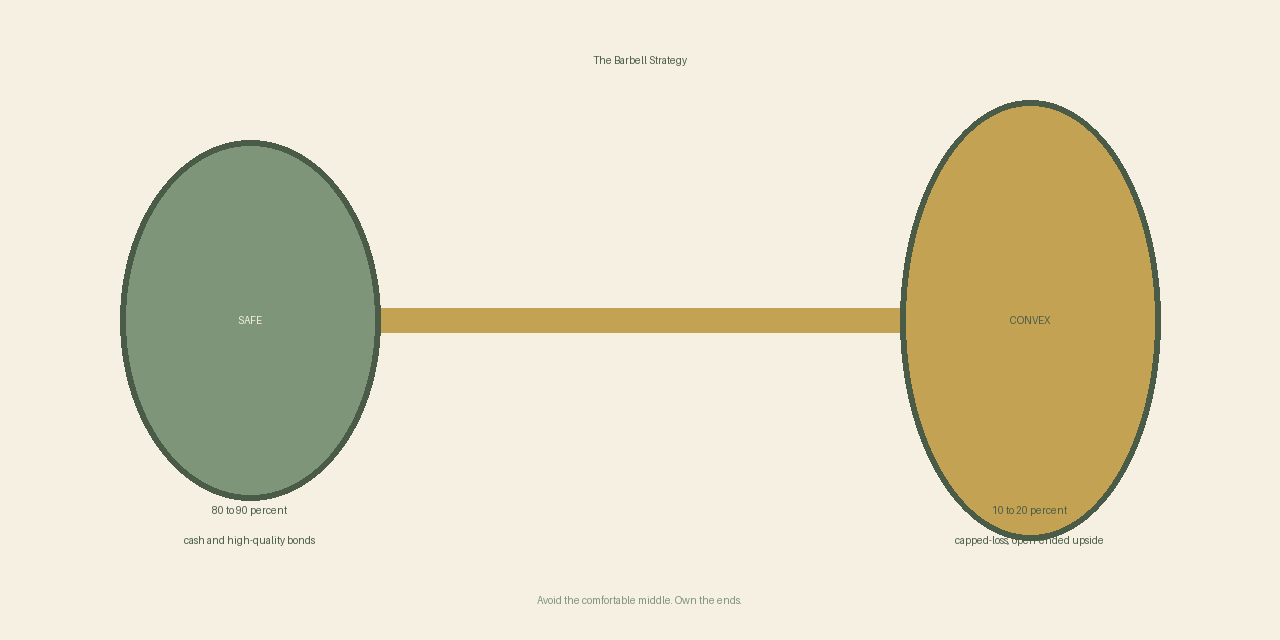
The barbell: eighty to ninety percent in safety, ten to twenty percent in defined-loss convex risk, nothing in the comfortable middle.
- The safe end is not an opinion. It is cash, short-duration high-quality government bonds, and inflation-linked bonds. Its job is to keep the lights on and hand you dry powder when the world discounts everything at once.
- The convex end is where you take real, well-defined risk. Small, sized positions where the most you can lose is the premium or the position itself, and where the upside is not artificially capped.
- The missing middle is the comfortable stuff. Fully invested balanced funds, single-country concentrated equity, leveraged property with thin serviceability. It looks safe in normal years and disintegrates in the ones that count.
The barbell is not an all-weather promise. It is a shape. What sits at each end is your call, driven by valuations, your time horizon, and how much loss you can wear without becoming a forced seller.
Convexity: The Only Payoff Profile Worth Chasing
The whole edifice rests on one geometric idea. A convex payoff is one where the upside from a favourable move is larger than the loss from an unfavourable move of the same size. A concave payoff is the reverse: symmetric-looking on paper, brutally asymmetric in practice.
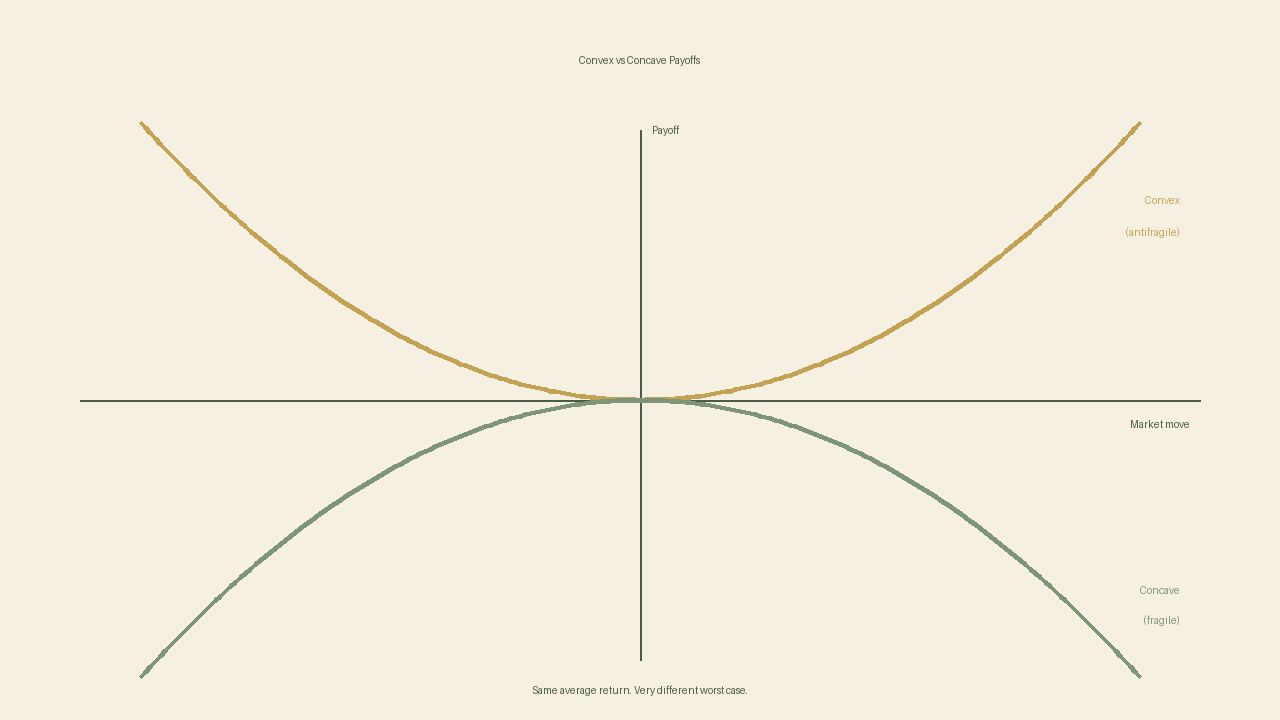
Same average return, very different worst case. The shape of the payoff decides the outcome.
This is why average returns are one of the most misleading numbers in finance. Two portfolios can share the same average and one of them will quietly ruin you. The one that ruins you is the one whose payoff curve bends the wrong way when things get interesting.
What Does Antifragility Look Like In A Real Australian Portfolio?
We are not going to recommend specific holdings, because that is not what this newsletter does. But the categories are worth naming, because most investors have never sized them together.
- A large ballast of genuine safety. Cash and short-duration Australian and US government bonds. The point is not to earn a return here; it is to be liquid when everything else is illiquid.
- Broad, boring core equity. Diversified low-cost index exposure sized so you can hold it through a 40% drawdown without behaving badly. Our free ETF course walks through what "sized properly" actually means.
- Real assets with income. Commodities, energy, and selected infrastructure. This is where our current podcast bias sits, because we think the next fifteen years will reward yield and hard assets more than the last fifteen did.
- Small convex bets. Sized so the maximum loss is a rounding error on the whole plan, aimed at outcomes where being right pays multiples rather than percentages.
- Optionality, not prediction. Enough dry powder, structured deliberately, so a genuine dislocation is an opportunity rather than a threat.
Want the objective version of "am I actually diversified"? Our free ETF course walks through how to compare what you own on return, cost and correlation rather than name. Start the free course.
Via Negativa: What To Take Out
Half of antifragility is subtraction. Taleb calls it via negativa: you get more resilient by removing sources of hidden ruin, not by adding cleverness on top. Applied to a portfolio, that reads as a short list of things to stop doing.
- Stop using leverage you cannot service at a stressed rate. APRA already assesses new mortgages at the contract rate plus 3%. Use the same buffer on yourself.
- Stop concentrating in a single country, sector, or theme. The AI trade is not a diversifier if it is 30% of your equity book and 20% of the index you already own.
- Stop selling insurance you cannot pay out on. That includes yield strategies whose losses only appear in the tail, and any position whose downside you have not actually modelled.
- Stop trading your plan for a story. Recency bias, path dependence, and confirmation bias each cost more than most fees. Our market cycle guide walks through why.
"We have been fragilising the economy, our health, political life, education, almost everything, by suppressing randomness and volatility." — Nassim Nicholas Taleb, Antifragile
Skin In The Game, Ergodicity, And Why This Is Personal
Skin in the Game makes a point that maps directly onto how you own risk. If you do not personally bear the downside of a strategy, the strategy is not really yours; it belongs to whoever pays when it fails. In portfolio terms, that means asking who wears the loss when your plan is wrong. If the answer is you, and you cannot survive that loss, the plan is fragile whatever the brochure says.
This is also where ergodicity, which we come back to constantly, matters. The market's long-run average return only exists if you are still in the market to collect it. A path that includes a ruinous drawdown at the wrong moment does not converge on the average; it just ends. Building antifragile is really building a portfolio whose path lets you keep playing.
Choose The Barbell, Or Choose The Middle
An antifragile approach may suit you if: you would rather forgo some average return in exchange for a much smaller worst case, you accept that most of your capital should sit somewhere quiet, and you are willing to size small convex positions properly rather than treating them as your whole plan.
The comfortable middle may suit you if: your time horizon is short enough that a normal year matters more than a bad one, your income can absorb a drawdown without behavioural damage, and your plan already assumes the current regime continues long enough for that middle to compound.
Numbers Over Narrative
An antifragile portfolio is not a product, a fund, or a clever ticker. It is a shape: mostly boring, occasionally convex, quietly liquid, deliberately incomplete. It does worse than the crowd in an easy year and much better than the crowd in the year the crowd stops posting. Taleb's contribution was to give investors a vocabulary for the geometry that already decided most of their outcomes. Ours, at Total Money Management, is to keep pointing at that geometry until the numbers do the arguing instead of the narrative.
Frequently Asked Questions
Is an antifragile portfolio the same as a defensive portfolio? No. A defensive portfolio tries to reduce loss by owning less risky things overall. An antifragile portfolio deliberately combines a very safe majority with a small, well-defined risky slice whose upside is uncapped. The average risk can look similar. The payoff shape is fundamentally different.
Does the barbell mean I should hold no diversified index funds? Not at all. Broad low-cost index exposure is a legitimate way to hold the middle of the barbell if it is sized to survive a large drawdown. What antifragility argues against is holding it on leverage or as your only exposure while assuming the current cycle continues.
How much of my portfolio should sit in the convex end? Small enough that losing all of it does not change your plan, big enough that a good outcome moves the needle. For most investors that lives in the low double digits at most. Sizing depends on your time horizon and how much of the safe end you can genuinely fund.
Where does property fit into an antifragile approach? Property with modest leverage, positive cash flow, and a long horizon can behave more like the middle of the barbell than most owners assume. Property with thin serviceability at today's rates has a concave payoff that looks fine until it does not. Our recent piece on the RBA and property works through the actual numbers.
What should I read next after this? Taleb's Antifragile is the source. Fooled by Randomness, The Black Swan and Skin in the Game round out the idea. For a more market-focused companion, Howard Marks' Mastering the Market Cycle was the subject of our market cycle guide and pairs unusually well with Taleb.
For a good external primer on where the language comes from, the CFA Institute has a short paper on creating antifragile portfolios that is worth a read.
Want this thinking applied to your own numbers? Our premium community reviews real portfolio shapes every month, not generic commentary. Learn more about the community.
This blog is for informational purposes only and does not constitute financial advice. Total Money Management | AFSL 568642.
Enjoying our blog?
Join Signals & Noise, our free weekly newsletter, and stay sharp on the markets and sectors we're tracking.
This newsletter is for informational purposes only and does not constitute financial advice. Total Money Management | AFSL 568642.
Stay connected to our blog
Join our mailing list to receive the latest news and updates from our team including blogs, live events, podcast releases and stocks to watch.
Your information will not be shared.
We hate SPAM. We will never sell your information, for any reason.
